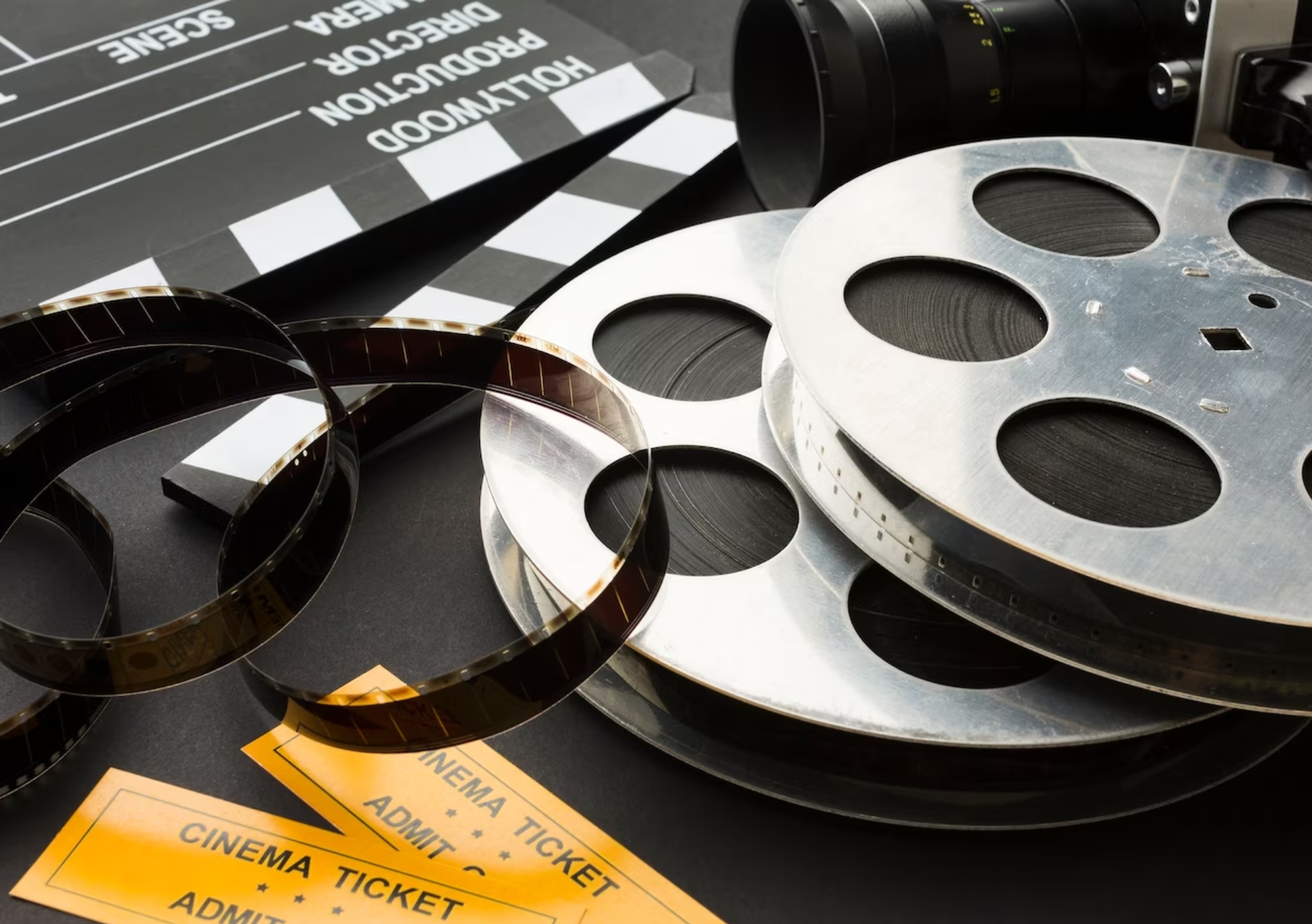
Convert 8mm Film to Digital: Preserve Your Memories Forever
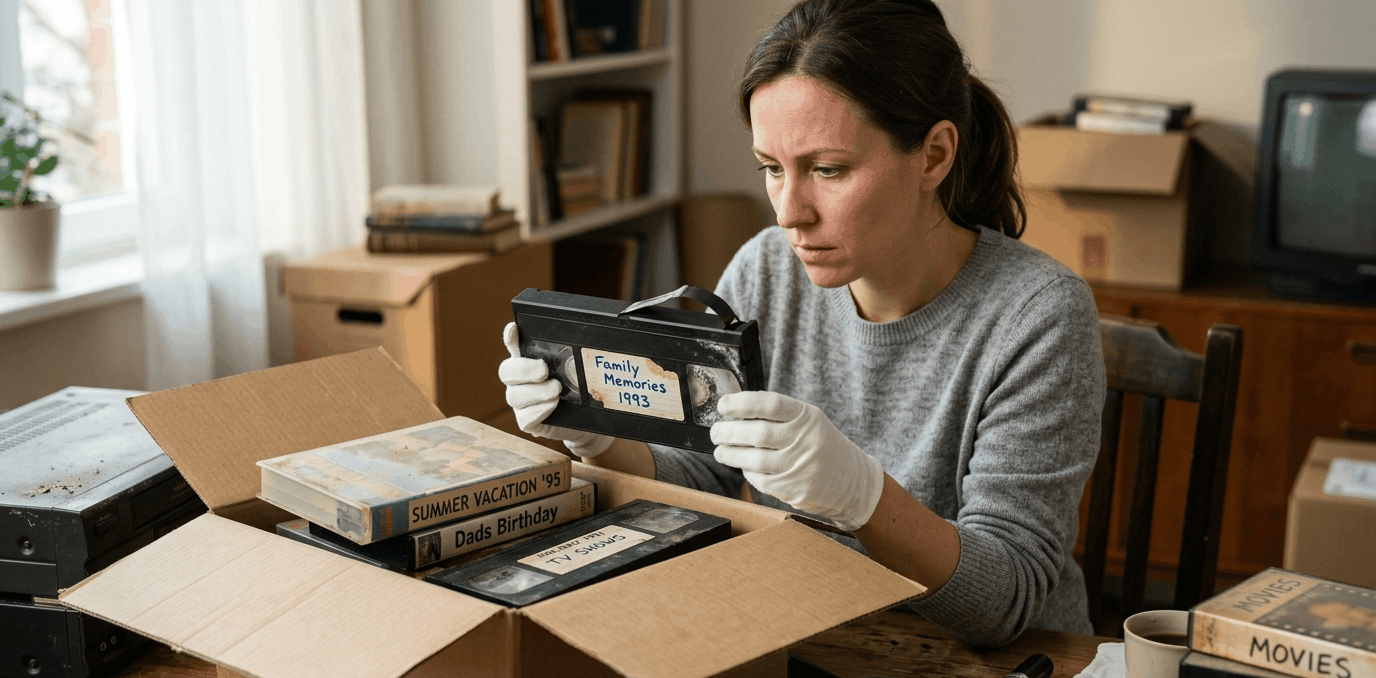
Buried in a closet, tucked into a shoebox, or gathering dust on a basement shelf, millions of 8mm film reels hold some of the most precious moments in family history. First birthdays, wedding days, childhood summers, holiday gatherings, scenes that exist nowhere else but on those delicate strips of celluloid.
The problem? 8mm film was never built to last forever. Every passing year brings your family’s visual history one step closer to permanent loss. Converting 8mm film to digital is no longer just a nice-to-have, it is an act of preservation that future generations will thank you for.
Whether you have Standard 8mm or Super 8mm reels, All Media Transfers offers professional, high-quality digitization services that bring those flickering images back to vivid, watchable life, and keep them safe for decades to come.
Every year you wait, your memories fade a little more. Converting 8mm film to digital is the single most important thing you can do to protect your family’s visual legacy.
What Happens to Old 8mm Films Over Time?
Film is an organic medium, and like all organic materials, it degrades. Even if your reels look fine on the outside, the damage happening inside is silent and relentless. Here is what your 8mm films face every day they sit unwatched:
- Vinegar Syndrome: As acetate film decomposes, it releases acetic acid, creating a sharp vinegar smell and causing the film to shrink, buckle, and become brittle.
- Color Fading: The dye layers that form the image are light-sensitive and unstable. Over time, colors shift, fade, or take on a reddish-orange cast as the cyan and yellow dyes deteriorate faster than the magenta layer.
- Mold and Fungal Growth: Humidity encourages mold to grow directly on the film’s emulsion surface, eating through the image layer and leaving permanent cloudy patches.
- Brittleness and Breakage: Old film becomes fragile. Running deteriorated footage through a projector risks snapping it entirely, destroying frames that can never be recovered.
- Shrinkage: Film that has shrunk even a fraction of a millimeter can no longer pass through standard projector gates, making it unplayable without professional intervention.
- Dust and Scratches: Even proper storage can’t prevent the micro-abrasions that accumulate over decades, dulling the clarity of your footage.
The window to save your 8mm films is narrowing. Films from the 1950s through the 1980s are now entering an advanced stage of degradation, and experts estimate that many reels will be unsalvageable within the next 10 to 20 years.
Benefits of Converting 8mm Film to Digital
Digitizing your 8mm reels is more than a technical upgrade, it is a transformation that makes your memories more accessible, shareable, and durable than ever before. Here are the key benefits:
Protect Your Memories Permanently
Digital files do not degrade, shrink, or develop mold. Properly backed up, your converted footage can last indefinitely, immune to the physical decay that threatens your original reels.
Watch Anytime, Anywhere
No projector. No darkened room. No rewinding. Once digitized, you can watch your family films on a smartphone, tablet, smart TV, or laptop whenever the mood strikes.
Easy Sharing with Family
Share a clip via text, upload to a private YouTube link, or create a beautiful slideshow presentation. Digital files make it effortless to connect generations around shared memories.
Enhanced Video Quality
Professional scanning and digital restoration can dramatically improve the clarity, brightness, and color accuracy of your footage, often revealing details invisible even on the original projector.
How Our 8mm Film Conversion Process Works
At All Media Transfers, we have perfected a meticulous, multi-stage process that treats your irreplaceable reels with the care and expertise they deserve. Here is what happens from the moment your films arrive to the moment you receive your digital files:
1. Inspection & Preparation
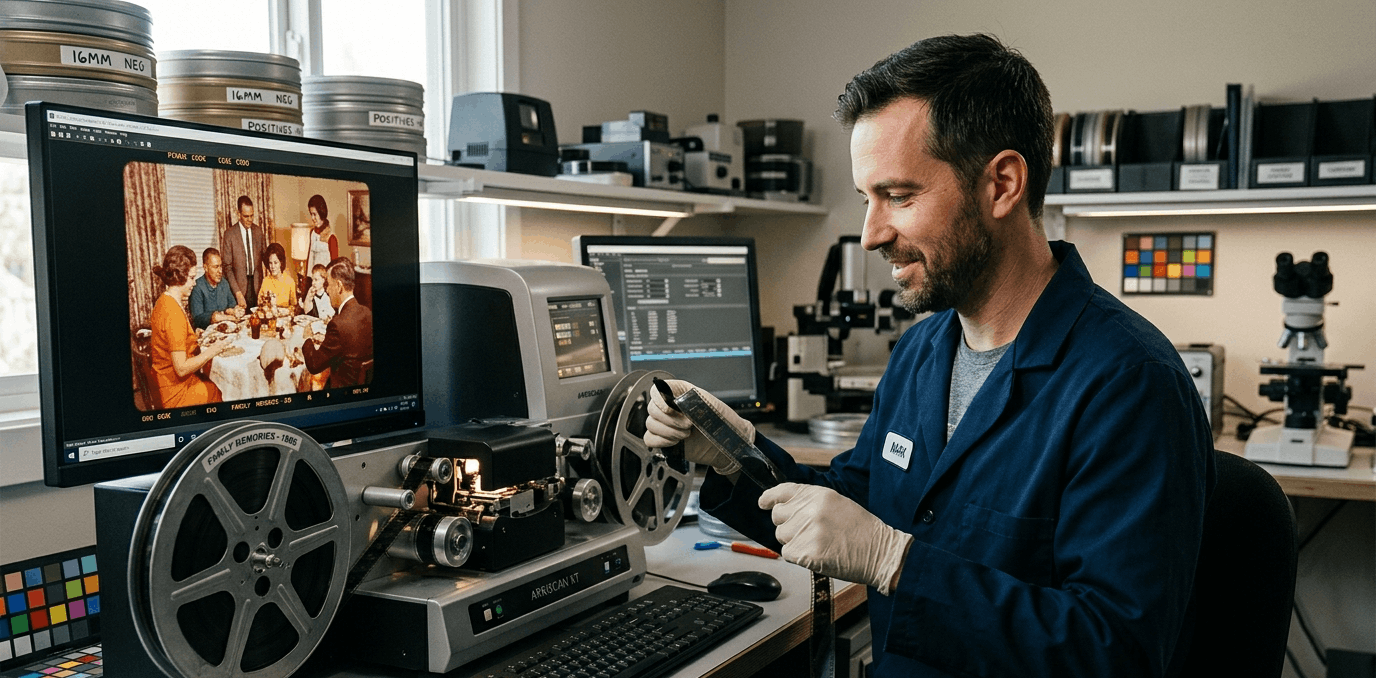
Every reel undergoes a thorough inspection by our trained technicians. We assess the film’s physical condition, identify the format (Standard 8mm or Super 8mm), look for breaks, splices, shrinkage, or mold, and gently clean the film using professional-grade solutions. Damaged sections are carefully repaired before scanning begins to ensure we capture as much footage as possible.
2. Scanning
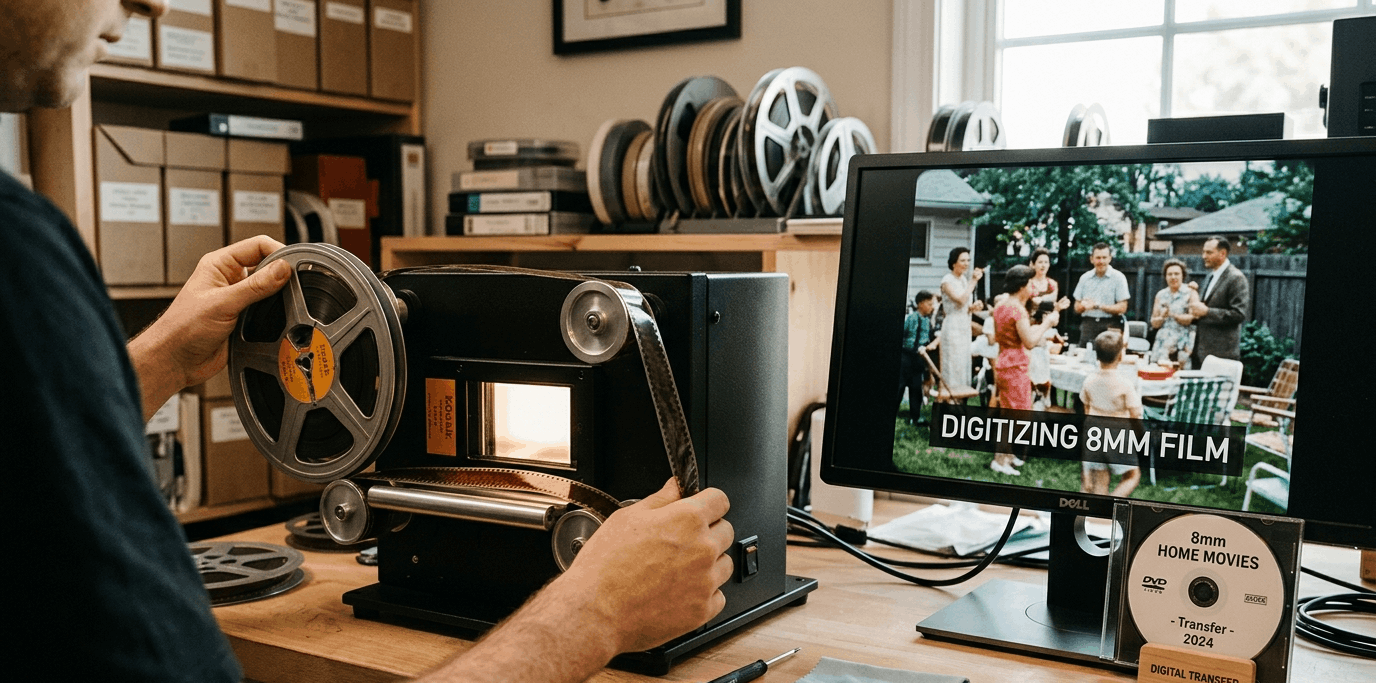
Your film is scanned using high-resolution, frame-by-frame capture technology. Unlike older telecine methods that simply project film onto a camera, our scanners capture each individual frame at up to 4K resolution, preserving every detail in the image. We scan at a native frame rate to maintain the authentic look of your footage, including the beautiful film grain that gives old home movies their distinctive character.
3. Restoration
After scanning, our editors use professional restoration software to enhance your footage. This includes color correction to address fading and yellowing, grain reduction for cleaner images, exposure adjustment for footage that is too dark or washed out, and stabilization to smooth out camera shake that was common with handheld 8mm cameras. We balance authentic preservation with meaningful improvement, your memories look their best without losing their nostalgic soul.
4. Delivery
Your digitized films are delivered as high-definition MP4 files, the most universally compatible format, along with your original reels returned safely packaged. Files are available for download via a secure private link, on USB drive, or on DVD. We also offer cloud storage options for added peace of mind.
Why Choose All Media Transfers
With dozens of film digitization services on the market, why trust All Media Transfers with your irreplaceable memories? Here is what sets us apart:
Frame-by-Frame Precision
We capture every single frame individually, not a video recording of a projected image, for the sharpest possible result.
All Film Types Accepted
Standard 8mm, Super 8mm, and even damaged or deteriorated reels, we handle them all with equal care.
Your Originals Returned Safely
Your physical reels are returned to you after digitization, packaged with the same care they arrived with.
Thousands of Happy Customers
We have preserved memories for families across the country, read our reviews and see why customers trust us.
Transparent, Fair Pricing
No hidden fees. Clear per-reel pricing with options to suit every budget and reel count.
Secure Handling
Your reels are tracked throughout the process and your digital files are kept on secure, backed-up servers until delivery.
Tips to Safeguard Your Digital Memories
Once your 8mm films have been converted to digital, the work is not quite done. Here is how to ensure your digital files remain safe and accessible for generations:
- Follow the 3-2-1 Backup Rule: Keep 3 copies of your files, on 2 different types of media (e.g., hard drive + cloud), with 1 copy stored off-site or in the cloud.
- Use Reliable Cloud Storage: Services like Google Drive, iCloud, or Amazon Photos provide automatic, redundant backups of your most important files.
- Invest in an External Hard Drive: Store a full copy of your converted films on a dedicated external hard drive kept in a cool, dry location away from direct sunlight.
- Check Your Files Periodically: Every year or two, open your digital files and make sure they are still playing correctly. Hard drives can fail silently over time.
- Use Future-Proof Formats: MP4 (H.264 or H.265) is the most widely supported video format, avoiding proprietary formats that may not be readable in 20 years.
- Label Everything Clearly: Name your files with dates, names, and events (e.g., “Henderson_Family_Christmas_1972.mp4”) so future generations know exactly what they are watching.
- Share with Family Members: Give digital copies to multiple family members. The more people who have the files, the less likely they are to be lost entirely.
Frequently Asked Questions
Q1. How long does it take to convert 8mm film to digital?
Turnaround time typically ranges from 2 to 4 weeks depending on the number of reels and our current order volume. If you need your footage sooner, rush processing options are available, contact us to discuss your timeline.
Q2. What format will my converted 8mm film be delivered in?
We deliver your digitized films as high-definition MP4 files, compatible with all modern devices, smart TVs, computers, and smartphones. DVD delivery is also available upon request for those who prefer a physical format.
Q3. Is my 8mm film safe during the conversion process?
Absolutely. Our technicians handle every reel with white-glove care using proven, film-safe cleaning and scanning techniques. Your original films are always returned to you after the conversion is complete, packaged securely for safe transit.
Q4. Can you convert damaged or severely degraded 8mm film?
Absolutely. Our enhancement process revives faded colors and stabilizes footage for clear, vibrant playback.
Q5. What types of 8mm film do you convert?
We convert both Standard 8mm (also called Regular 8mm or Double 8mm) and Super 8mm film. If you are not sure which type you have, our team will identify the format during the initial inspection phase at no extra charge.
Q6. How much does 8mm film conversion cost?
Our pricing is transparent and competitive, based on the number of reels you send. Visit our services page for a full breakdown, or contact us for a custom quote on larger collections.
Q7. Do I need to do anything to prepare my reels before sending them?
No special preparation is needed. Simply pack your reels carefully in a sturdy box with padding to prevent damage in transit. We take care of everything else from there, including inspection, cleaning, repair, scanning, and restoration.